Vol. 127 Clorox: Going organic 🧼
How Clorox built an organic social-first strategy that generates millions of impressions across brands
14 May 2026
Vol. 127 Clorox: Going organic 🧼
How Clorox built an organic social-first strategy that generates millions of impressions across brands

Case Studied
May 14, 2026


Case Studied
From squeaky clean to unhinged
More and more, we’re seeing brands experiment with different social media strategies. And it’s both entertaining and enlightening.
Duolingo and Ryanair both lean into absurdity. Nutter Butter's TikTok account looks a lot like a fever dream. And all of them saw strong organic engagement from it. Recently, Clorox launched a similar strategy.
This week, Case Studied explores how Clorox restructured its marketing team and built an organic social-first strategy that's generating millions of impressions.

Misaligned sales and marketing is quietly killing B2B pipelines. Join Sandra Georgescu and Bianca Bulat for a free live webinar on 27 May (11:00 BST) to get the practical playbook: how to align on ICP, fix your pipeline handoffs, and build feedback loops that actually move revenue.
The Brief

The Clorox Company is one of the largest consumer packaged goods companies in the United States. Founded in 1913, it's home to a wide portfolio of household brands including Pine-Sol, Brita, Hidden Valley, Glad, Kingsford, and its flagship Clorox cleaning line.
For most of its history, when Clorox's brands showed up on social media, they did so through paid placements. Organic content was an afterthought relative to the company's larger media strategy.
But heading into late 2024, Clorox was facing an 8% drop in net sales in its fiscal third quarter. The decline was driven by what CEO Linda Rendle described as a "tougher consumer environment.” The company began taking a hard look at how it was building relationships with consumers.
In this challenge, the company's senior VP and CMO Eric Schwartz saw an opportunity to change direction. Rather than treating social purely as a paid media channel, he wanted to build a presence that consumers would actually seek out, engage with, and return to. To test whether that kind of connection was possible, the company began piloting an organic social-first approach with a handful of brands in the fall of 2024.
The Execution

Clorox began testing its new organic social approach with three brands: Pine-Sol, Brita, and Clorox. Rather than broadcasting product messaging, the initial pilots leaned into the absurdist, playful content formats that are native to TikTok.
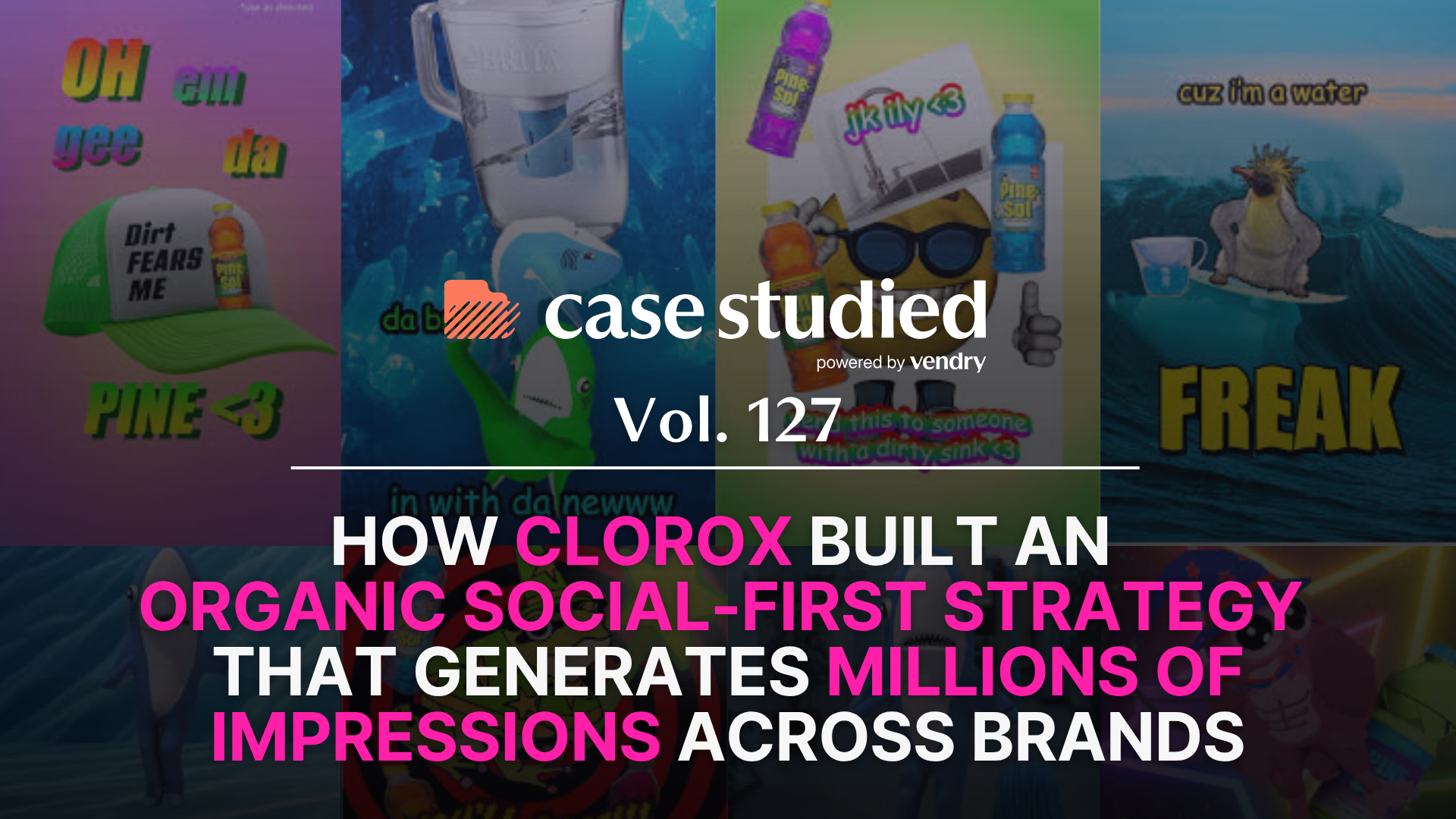
Pine-Sol's TikTok presence became the clearest expression of this new direction. The account developed a visual identity built around illustrated wizards, neon colors, and poor-on-purpose graphic design. A nonsensical phrase, "oh em gee da Pine", became the brand's unofficial TikTok slogan.
Brita pursued a similar tone, with autotuned jingles and content engineered to get stuck in your head. This included a video about what it means if your partner doesn't refill the Brita filter (their answer ➡️ divorce).
@britausa i’m just not into dating right now hope you understand #thirst #hydrated #song #unhinged
When those pilots started gaining traction, Schwartz restructured the company's marketing organization. The social media practitioners scattered across Clorox's individual brands were consolidated into one centralized social team, housed within Clorox's in-house creative agency, Electro Creative Workshop. The team works alongside external agency partners including VaynerMedia, Interpublic's FCB, and Ketchum.
The company calls the strategy behind this content "cohort targeting." Rather than organizing content around demographics, Clorox's senior director of marketing Rita Gorenberg and her team created content based on shared experiences and interests of different cohorts.
One of Brita's top-performing posts, for example, targeted married couples who share domestic chores. The team identified upwards of a dozen such cohorts per brand and continuously evaluated which ones are sticking. Gorenberg said, "As you see what [content] works, you keep a cohort or you evolve a cohort. For ones that aren't sticky, you replace it with another insight—a new cohort."
Today, the centralized team produces between 300 and 400 pieces of content per month across Clorox's entire brand portfolio. In addition to TikTok, Instagram, and Facebook, the team is also experimenting with Reddit as part of a broader social search strategy. Gorenberg noted that nearly half of Clorox's organic video views now begin in social platform search bars.
The Results
The organic social pivot produced measurable results quickly. Halfway through the Pine-Sol pilot, the brand had already surpassed its original impression goals twice. Posts that previously required paid support to gain traction were now generating 2 to 3 million impressions organically.
On the Brita side, a video targeting the “married couples who share domestic chores” cohort accumulated nearly 450,000 views and more than 62,000 likes on TikTok. A separate post featuring a refrigerator drawer filled with matcha generated enough buzz to earn media coverage—an outcome Gorenberg described as the "flywheel" the social team had been working toward.
The jingles developed for both Pine-Sol and Brita performed well across demographics, resonating not just with Gen Z but with millennials and older consumers as well. Demand for a Spotify playlist collecting all the brand jingles came directly from consumers.
@pinesol Sponges want me, dirt FEARS ME 😤 #cleaning #cleantok #unhinged #pinesol #newmusic
The Takeaways
1) Build for the platform, not the brand guidelines.
Clorox's success with organic content came, in part, from giving its social team permission to make things that looked and felt native to TikTok. They did this even when it meant misspelling "Brita" as "Bwita,” which some executives of a certain mindset might’ve immediately nixed. Schwartz specifically noted the importance of insulating the social team from internal pressure to default to traditional advertising norms.
If your brand has a presence on social platforms, take an honest look at whether it reads as platform-native content or repurposed ad content. The two are easy to tell apart. Platform-native content tends to be more reactive and rooted in the specific humor and formats of that channel. Repurposed ad content is polished and more on-the-nose. If yours is leaning towards the latter, consider how you can adjust your approach.
2) Target audiences based on experiences, not demographics.
Clorox moved away from demographic targeting and started building content for groups of people who share a specific experience or relationship. While it breaks from traditional marketing standards, this allowed the brand to speak more directly to these audiences and the engagement quickly followed.
Think about who your customers are in terms of the experiences they share, not just the attributes they share. An experience-based approach asks different questions than a demographic one. It’s the difference between “who buys our product" and "how does our product show up in people’s lives." Even a handful of well-defined “cohorts” can generate a significant content roadmap.
3) Give organic content room to breathe.
Schwartz acknowledged that experienced CPG executives, himself included, tend to reach for measurement frameworks before strategies have had time to develop. He deliberately shielded the social team from that impulse in the early stages of Clorox’s social revamp. So instead of worrying about proving ROI, the team had room to develop a jingle, define an absurdist visual identity, and iterate on cohorts.
When testing a new content strategy or channel, give yourself time to evaluate its stickiness. Too much measurement too soon tends to kill experiments before they find their footing. You can build a testing roadmap that has both proper runway and accountability.
Reach into the inbox: Did you know you can advertise in the Case Studied newsletter? That means having a direct line to 41,000+ senior marketers via a newsletter with a 52% open rate.
Don't miss the next Case Studied™.
Join 40,000+ marketers and receive a breakdown of the world's best brands every week.