Biggest moves in marketing this week
Ketchup, Jeffs, and a $111 billion problem
25 Jun 2026
Biggest moves in marketing this week
Ketchup, Jeffs, and a $111 billion problem

Case Studied Brief
June 25, 2026

Case Studied Brief
World Cup wins, media consolidation, and AI that means business
This week's Brief covers brands cashing in on the beautiful game, a media landscape reshaping itself through major deals, and an AI industry that's moved from pilot to production.
Verizon made a Calvin Klein-esq ad for a phone plan. Heinz turned a taped-over bottle into a campaign. And Etsy took aim at Prime Day with 5,000 guys named Jeff.
PMC swallowed Vox Media to become the world's largest digital publisher, senators moved to block the biggest media merger in years, and Fox became the first major upfront presenter to close negotiations.
Here's what you need to know.
Campaigns of the week 📺
Verizon
The least telecom-looking telecom ad
Verizon released a second spot for its Simplicity Plan, this one a sharp creative departure from the Dr. Evil and Yo soy Betty, la fea campaigns running simultaneously. Titled "Simplicity is Sexy," the one-minute black-and-white film stars Stephen Kalyn aka the breakout lead of Prime Video's hit hockey romance series Off Campus. It was directed by Bardia Zeinali, the same director behind Calvin Klein's “Deal With It” campaign. Shot on film with Kalyn dancing and moving to "Hey Hey What Can I Do" by Led Zeppelin, the spot is a deliberate riff on iconic Calvin Klein advertising, leaning into the brand language of luxury fashion rather than telecom. Verizon CMO Leslie Berland described the creative intent as blending "nostalgia with current zeitgeist." The spot sits alongside Verizon's broader Simplicity Plan launch, which also features a campaign with Connor Storrie, the lead of another Prime Video series, Heated Rivalry, directed by Nia DaCosta.

Why it stood out: Running three visually and tonally distinct campaigns for a single product launch is an unusual move. But this latest installment of Verizon’s campaign is arguably the most distinctive of the three. The casting marks Kalyn’s first major brand deal following his Off Campus's debut, which positions Verizon differently than an established celebrity would. Between Kalyn’s casting and the ad’s luxury fashion aesthetic, Simplicity is Sexy stands out from the typical creative approach seen in telecom.
📖 Read more: The Hollywood Reporter
Heinz
Even censored, the label still wins
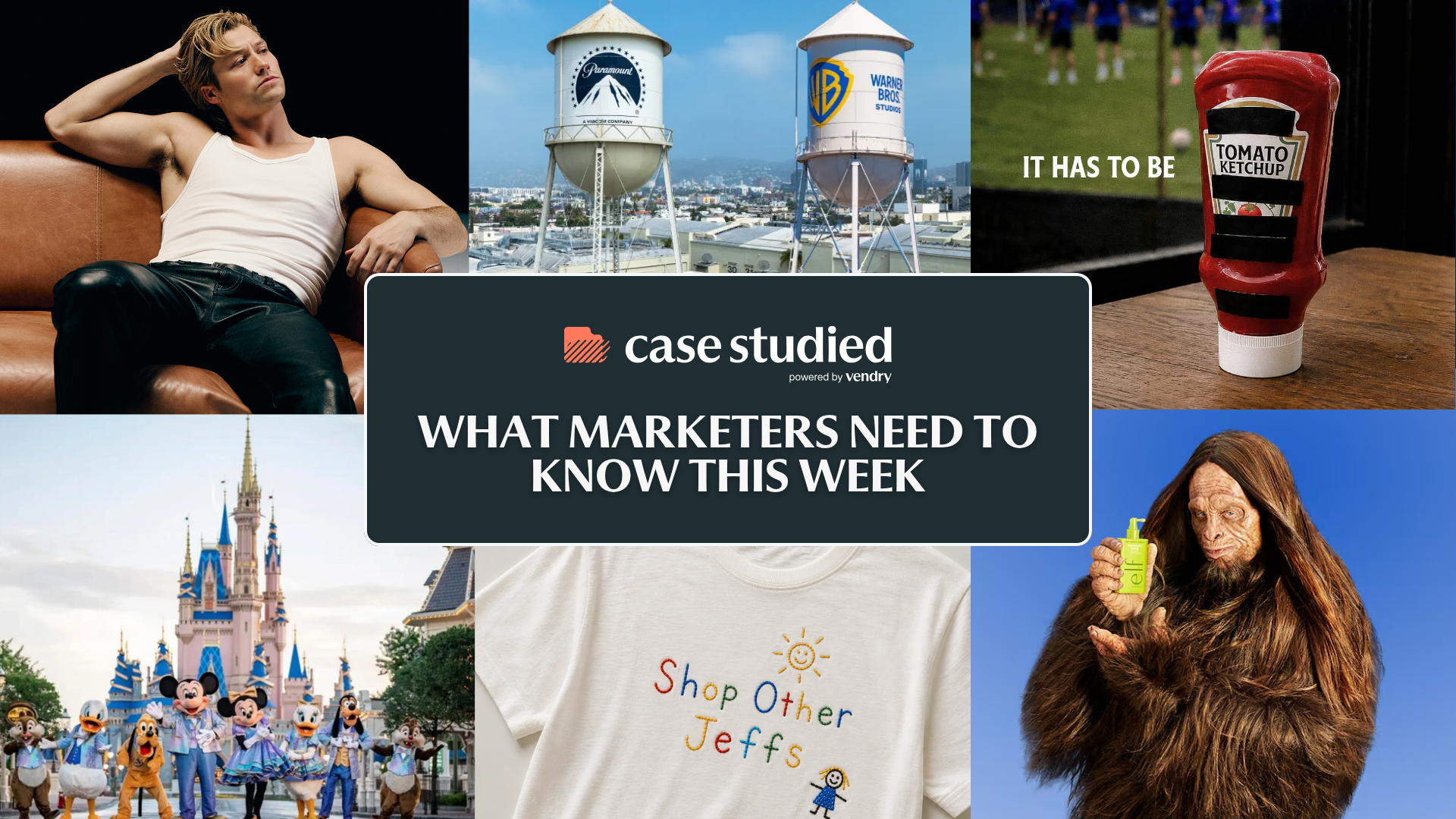
During the FIFA World Cup 2026, strict stadium sponsorship rules forced staff to tape over non-official brand labels, including Heinz ketchup bottles. Photos of the covered bottles soon circulated online, with fans noting that even completely obscured, the shape was still recognizable. Heinz Canada responded with an "Unofficial Stadium Ketchup" limited-edition bottle that intentionally mimics the taped-over look. Fans in Toronto can get the censored bottles and pocket-sized packets, while fans across Canada can join the conversation on Heinz's Instagram. Developed with Zeno Group Canada, the activation is deliberately lo-fi in execution, matching the energy of the original viral moment.

Why it stood out: Heinz didn't create this moment but it moved quickly to build on it. The decision to lean into being covered up, rather than fighting it, proved to be a reactive marketing win for the brand. And the fact that the bottle shape is distinctive enough to carry the joke without any explanation says a lot about Heinz’s brand equity.
📖 Read more: LBBOnline
Etsy
Meet the Jeffs who actually make things
Etsy launched "Shop Other Jeffs," a campaign timed to Prime Day that spotlights the more than 5,000 sellers named Jeff on its platform—woodworkers, ceramicists, lighting designers—as a stand-in for its nearly 6 million independent sellers. The campaign rolls out across broadcast TV, paid social on YouTube and TikTok, out-of-home in New York, Seattle and Washington D.C., and a full site and app takeover. It's also backed by limited-edition "Shop Other Jeffs" merchandise that’s designed and sold exclusively by actual Etsy sellers. The campaign is positioned as the next chapter in Etsy's "Celebrate Being Human" brand platform. Three featured sellers anchor the campaign's storytelling: Jeff Brown of Jeff Brown Pottery, who’s been making pottery by hand since 1977; Jeff Zabriskie of LUXGEN, who learned woodworking from his father; and Jeff Risinger of BootsNGus, who turned lamp-making into a business that ships handcrafted lighting fixtures around the world.
Why it stood out: The campaign name implies its comparison without ever making it directly. The decision to sell campaign merchandise through Etsy sellers themselves helps unify the message and the method. And spotlighting sellers' names, backstories, and products (which are shoppable directly from the campaign page) helps further strengthen the campaign’s narrative.
📖 Read more: Etsy \ Shop Other Jeffs
Industry news 🤝
PMC swallows Vox and rewrites digital publishing
Penske Media Corporation acquired the remaining brands of Vox Media—including The Verge, Eater, SB Nation, Thrillist, PopSugar, The Dodo, and Punch—along with Vox's premium ad marketplace Concert and its first-party data platform Forte. The deal makes PMC the world's largest digital publisher. To house the combined portfolio, PMC created a new subsidiary called PMX, which now spans more than 25 titles including Variety, The Hollywood Reporter, Deadline, Rolling Stone, Billboard, WWD, Robb Report, IndieWire, Sportico and all newly acquired Vox brands. Ryan Pauley, who served as president of Vox Media, will join PMC as president of PMX, reporting to PMC chairman and CEO Jay Penske and PMC president Craig Perreault. The deal follows the earlier sale of New York magazine, Vox.com, and the Vox Media Podcast Network to James Murdoch's Lupa Systems, which formally concluded the multiyear breakup of Vox Media as a standalone entity. PMC was already Vox Media's largest shareholder before the transaction, having taken a 20% stake in 2023. The combined PMX portfolio now reaches hundreds of millions of people monthly and produces more than 300 live events per year.

What it signals: Media consolidation at the publisher level is accelerating and owning the full commercial stack is a big part of it. PMC's acquisition of Forte may be as consequential as the editorial brands it came with. As cookies continue their slow decline and advertisers increasingly demand verified first-party audience relationships, owning that infrastructure gives PMX a serious commercial advantage.
📖 Read more: Variety
Sponsored
The brands scaling influencer marketing in 2026 aren't bigger. They're running a better system.
Creally is the AI platform for creator partnerships. AI agents run the full pipeline from discovery to signed deal, while your team focuses on strategy. One client went from 200 to 5,000 monthly outreaches without a single new hire. Another saw 2400% outreach growth in 30 days.
📖 See how it works: Creally
WPP and AWS bet big on agentic AI for brands
WPP Enterprise Solutions, the business transformation arm of WPP, signed a multi-year Strategic Collaboration Agreement with Amazon Web Services. The aim is to accelerate how enterprise brands deploy production-grade generative and agentic AI across commerce, customer experience, and marketing operations. The partnership gives WPP Enterprise Solutions teams access to a portfolio of AWS-built tools, including the Composable Content Engine, built on Amazon Bedrock, which enables franchisees and local markets to produce brand-compliant assets at scale with reported reductions of up to 90% in production time and 40% in content costs. A proof-of-concept deployment with United Rentals—the world's largest equipment rental company—delivered approximately a 70% improvement in helping customers identify the right equipment, built on Amazon Bedrock Agents.

What it signals: This agreement positions WPP Enterprise Solutions not just as a creative or strategy partner, but as an engineering and infrastructure layer. Gartner projects that by 2028, 60% of brands will use agentic AI to deliver personalized one-to-one interactions, and the WPP-AWS collaboration is a bet that holding companies will be the ones building those systems for enterprise clients. It also reflects a broader pattern that the biggest AI infrastructure deals in marketing are being struck at the network level, not the agency level, consolidating leverage in fewer hands.
Senators move to block the Paramount-WBD merger's July close
Three Democratic US senators—Cory Booker, Elizabeth Warren, and Adam Schiff—sent a formal letter to FCC Chairman Brendan Carr demanding the Commission prevent the $111 billion Paramount Skydance-Warner Bros. Discovery merger from closing until a government national security review of its foreign ownership structure is complete. At the center of the concern is Paramount's disclosure that the merged company would be 49.5% owned by foreign investors, with approximately 38.5% held by sovereign wealth funds from Saudi Arabia, Qatar, and Abu Dhabi. The senators specifically flagged Paramount's request to the FCC for advance approval of up to 100% indirect aggregate foreign equity ownership. They described this provision as "unprecedented" and "seemingly designed to fragment ownership across multiple vehicles." The Committee for the Assessment of Foreign Participation in the US Telecommunications Services Sector has begun a 120-day review, which the senators argue must be completed before any merger close. Paramount has pledged to close the transaction by September 30, after which it would owe shareholders a "ticking fee" of several million dollars per day, and the Justice Department closed its antitrust investigation last week without requiring divestitures. UK and EU regulatory clearances remain pending.

What it signals: The foreign ownership question is the most consequential unresolved issue heading into the summer and the senators' intervention raises the political and regulatory stakes. For advertisers and agency planners, the merger's outcome—and who ultimately controls CBS, CNN, and 28 broadcast stations—has real implications for upfront commitments, inventory access, and the linear TV landscape. The fact that the DOJ cleared the deal while senators pushed back through the FCC reflects how fragmented the regulatory scrutiny of major media consolidation has become.
📖 Read more: Deadline
MarTech moves 🤖
Disney and Adobe are building theme parks with AI
Adobe and Walt Disney Imagineering Research & Development announced a collaboration to bring Adobe Firefly Foundry into the Imagineers' design and pre-production pipeline. Firefly Foundry enables businesses to work directly with Adobe to create custom generative AI models trained on their own proprietary assets. In this case, Imagineering's own design catalog spans decades of franchise IP. Three initial workflows are in development: a sketch-to-image tool that turns rough hand-drawn concepts into polished 2D concept art, a custom image model generating on-brand assets across franchises including Frozen, Moana, Cars, and Mickey & Friends, and a 3D modeling capability that converts 2D renderings into construction-ready prototypes for engineering teams. The models are built on top of Adobe's commercially responsible Firefly foundation models rather than scraped internet data, which addresses enterprise concerns around IP fidelity and brand consistency. Adobe's partnership with Imagineering extends a decades-long relationship with the media and entertainment industry. The company has received multiple Academy Awards for scientific and technical achievement.

What it signals: This partnership signals how the world's most IP-rich creative organizations are approaching generative AI as a bespoke infrastructure investment. By training models on Imagineering's own catalog rather than public internet data, the organizations are making the case that custom, IP-safe generative AI is an enterprise-grade path forward. As Disney grows its footprint across parks, hotels, and cruises, the ability to iterate at speed without sacrificing creative standards could provide a serious advantage.
📖 Read more: Adobe Newsroom | The Walt Disney Company
Broadcast radio finally gets digital targeting
iHeartMedia unveiled AudioGraph, a suite of advertising capabilities that brings digital-like targeting, identity-based planning, and outcome-based attribution to broadcast radio. Built on technology from Triton Digital, AudioGraph uses a privacy-safe identity spine, enriched audience attributes from TransUnion data, and proprietary ID-level listening models to enable planning and measurement at the listener level while activating campaigns at broadcast scale. The gap AudioGraph closes is significant: broadcast radio accounts for 64% of audio consumption in the US and reaches more than 278 million consumers monthly through iHeartMedia's stations alone. Yet until now, it lacked the targeting and measurement infrastructure available in digital media. Early results show that campaigns planned and measured using AudioGraph IDs deliver a KPI outcome 75% higher than traditional demographic-based plans, per iHeartMedia. The platform supports direct DSP connectivity and is built to be interoperable with existing measurement partners including Magellan AI, PlaceIQ, and GroundTruth. Triton Digital is also positioning AudioGraph as an industry-wide solution, with plans to expand capabilities across the broader broadcast radio landscape in the US and globally in 2027.

What it signals: Broadcast radio has historically carried massive reach with limited measurement precision. AudioGraph addresses that gap and, in doing so, makes radio more directly competitive with digital and podcast inventory in a unified planning environment. For brands looking for authenticated, fraud-resistant reach at scale, a measurable broadcast radio product with DSP connectivity gives media planners a reason to revisit the format.
📖 Read more: iHeartMedia
ChatGPT ads just got a lower barrier to entry
StackAdapt dropped its minimum spend commitment for advertisers running ads inside ChatGPT through its self-serve model, eliminating the $50,000 floor it set when it launched its ChatGPT pilot in April. The move came after StackAdapt opened its self-serve offering to the broader market in May, with chief revenue officer Christian Gerron confirming to Adweek that the platform now operates with no minimums for the format. The timing here is notable: rival ad tech firm Criteo moved in parallel, cutting its own ChatGPT ad threshold from $50,000 down to $10,000 earlier in June. Criteo’s decision was a step in the same direction but not as aggressive as StackAdapt's outright elimination of the floor. The competing moves reflect intensifying rivalry among DSPs and ad tech platforms to establish early footholds in OpenAI's emerging ad business.

What it signals: The race to own the buy-side infrastructure for AI-native ad placements is underway, and dropping spend minimums indicates that platforms are prioritizing market share over margin in the early land-grab phase. As AI assistants become a primary discovery surface for consumers, the platforms that establish deep advertiser relationships now will have a structural advantage when that inventory matures. The gap between StackAdapt's no-floor approach and Criteo's $10,000 threshold also reflects that there's not a settled consensus yet on the pricing for this new format.
📖 Read more: Adweek
Nexxen opens its ad platform to external AI agents
Nexxen announced the next evolution of its nexAI platform, adding interoperability capabilities that allow external AI agents to connect directly to its advertising platform via open protocols including Model Context Protocol and Agent-to-Agent. This makes it one of the first ad tech platforms to support both in-platform AI usage and external agent integration simultaneously. In practice, the update means Nexxen customers can integrate the platform's data, planning, and activation capabilities into their own tools and AI workflows. New agent-powered workflows enable teams to run automated pre-launch campaign checks, surface spend recommendations inside their own planning tools, and query campaign performance in plain language through whichever AI assistant their team prefers. The announcement positions Nexxen's nexAI as what the company describes as an "open AI operating system" spanning its DSP, SSP, and DMP, with human-governed guardrails built in at each stage.

What it signals: Interoperability is becoming a new competitive advantage in ad tech. As agencies increasingly build in-house AI systems for media buying and optimization, ad tech vendors that open up via standard protocols will be more attractive to sophisticated buyers than closed systems. It's also a signal that media buying may become a workflow that AI agents execute end-to-end, with humans setting strategy and guardrails rather than executing individual transactions.
📖 Read more: Nexxen
Editors Choice 👀
🏀 Kalshi and Polymarket used the Knicks' NBA Finals run as a live street-marketing battleground 📖 Read more: NYT
🎭 Publicis coined "AI pitch-maxxing" to call out agencies overselling AI capabilities to win business. 📖 Read more: Adweek
📹 MrBeast became the first creator to hit 500 million YouTube subscribers, reaching 1.3 billion viewers quarterly. 📖 Read more: Adweek
🦁 At Cannes Lions this year, AI hype is giving way to practical, results-focused conversations. 📖 Read more: Marketing Brew
Reach into the inbox: Did you know you can advertise in the Case Studied newsletter? That means having a direct line to 41,000+ senior marketers via a newsletter with a 52% open rate.
Don't miss the next Case Studied™.
Join 40,000+ marketers and receive a breakdown of the world's best brands every week.