Vol. 105 Cards Against Humanity: Owning Black Friday 💯
How Cards Against Humanity staked a claim in Black Friday stunts
Case Studied Standout stunts
Each November, brands duke it out for attention, engagement, and sales on Black Friday.
Despite such a saturated environment, a few brands have found ways to stand out by doing the unexpected. Patagonia put an ad in the New York Times telling readers “Don’t buy this jacket.” REI doesn’t open stores at all on Black Friday. And for over a decade now, Cards Against Humanity has found new ways to metaphorically zig as other brands zag.
This week, Case Studied explores how Cards Against Humanity staked a claim in Black Friday stunts.
Cards Against Humanity launched in 2011 after a massively successful Kickstarter campaign, quickly becoming one of the top-selling party games on Amazon. Since the early days, the brand’s marketing has always been nihilistic, deadpan, aggressively self-aware, just like the game itself.
Black Friday provided an ideal moment for the brand to have some fun. From the beginning, they rejected the idea that a values-driven, satire-based brand should participate in mass discount culture.
❝
Founder Max Temkin once said “We really hate Black Friday. It’s this really gross orgy of consumerism right after a holiday about being thankful for what you have—so we’ve always tried to think of funny jokes or comments we could make about the tradition.”
Instead of competing with Black Friday, CAH used the holiday as a stage for stunts that fans anticipated as much as the game itself. And for 11 years straight, they delivered.
The Execution
Cards Against Humanity’s annual Black Friday campaigns followed a consistent creative formula: produce one single, simple (and usually absurd) idea, build a microsite around it, and let the internet spread the word.
The tradition began in 2013 when, instead of discounting their game, the brand raised the price by $5 for a Black Friday “anti-sale.”
The following year, they removed the game entirely from their online store and replaced it with a lone product called Bullshit. And yes, it was in fact a box of real, sterile bull feces that CAH sold for $6 a pop. This stunt leaned into the idea that if customers wanted to buy something on Black Friday simply because it existed, the team would offer the most meaningless product possible.
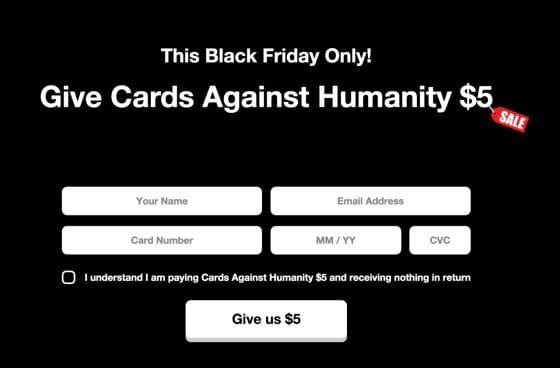
A year later, in 2015, they distilled that idea even further by selling absolutely nothing. The homepage simply urged shoppers to “Give Cards Against Humanity $5,” with the clear promise that nothing would be sent in return. The page mocked the traditional value exchange of Black Friday by removing one side of it altogether.
Then the brand expanded into more physical absurdity in 2016 by livestreaming a backhoe digging a giant hole in the ground. Located in Illinois, it was called Holiday Hole and CAH said it would continue digging for as long as folks were willing to pay for it via donations. The FAQ repeatedly refused to offer meaning or symbolism, with the site saying the hole existed “for no reason” (which was the entire point).
The 2017 Black Friday activation introduced a new layer: retail misdirection. Cards Against Humanity created a new product called Original Prongles, a fake potato chip brand that appeared on Target shelves. The packaging claimed the company was “pivoting to snacks” and the CAH website redirected to the chip brand, blurring satire with real-world shopping behavior.
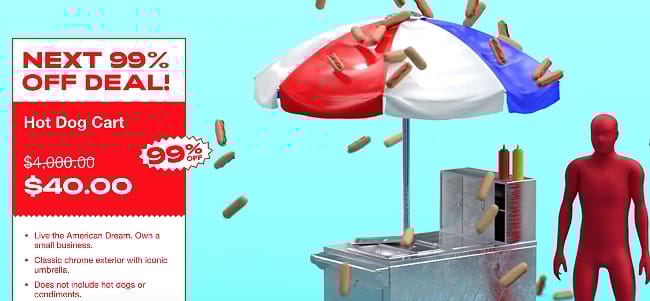
The brand channeled its Black Friday critique into the “99% Off Sale” in 2018, offering real items—ranging from electronics to jewelry to cash—at 99% off. Shown on a countdown-driven microsite, items disappeared instantly. The brand sold things as niche as medieval weapons and as practical as a used Ford Fiesta.
The next year, the brand turned its attention to AI with theBlack Friday A.I. Challenge. They released two $5 card packs—one written by staff writers, another written by an AI model—and told shoppers that whichever pack sold fewer units would determine whether the writers kept their jobs. It was a satirical take on automation that doubled as a mini social experiment.
In 2020, amid the pandemic and social upheaval, the brand paused the comedy and dedicated its Black Friday budget to nonprofit donations. The gesture kept the anti-consumerist spirit intact while acknowledging the gravity of the moment.
The following year, they returned to absurdity with a Cards Against Humanity Pays You $5 Sale, flipping the 2015 stunt on its head. Instead of asking shoppers for money, the brand offered to pay fans for completing bizarre tasks, ranging from the silly (tweeting at mayonnaise brands) to the surreal (mailing in teeth). Each task came with a different reward amount. For example, the person who guessed how many jelly beans were inside a 1993 Cadillac Allante was rewarded $10,000.
In 2022, CAH launched a new storage box called Bōks and hosted a 200% off sale on Black Friday. But in order to get the code, users had to complete a series of increasingly difficult CAPTCHAs. Some required them to identify tanks, while others asked users to identify “assholes” (which included photos of animal body parts and real people). Each code given out worsened the discount for everyone else, creating a competitive, comedic race.
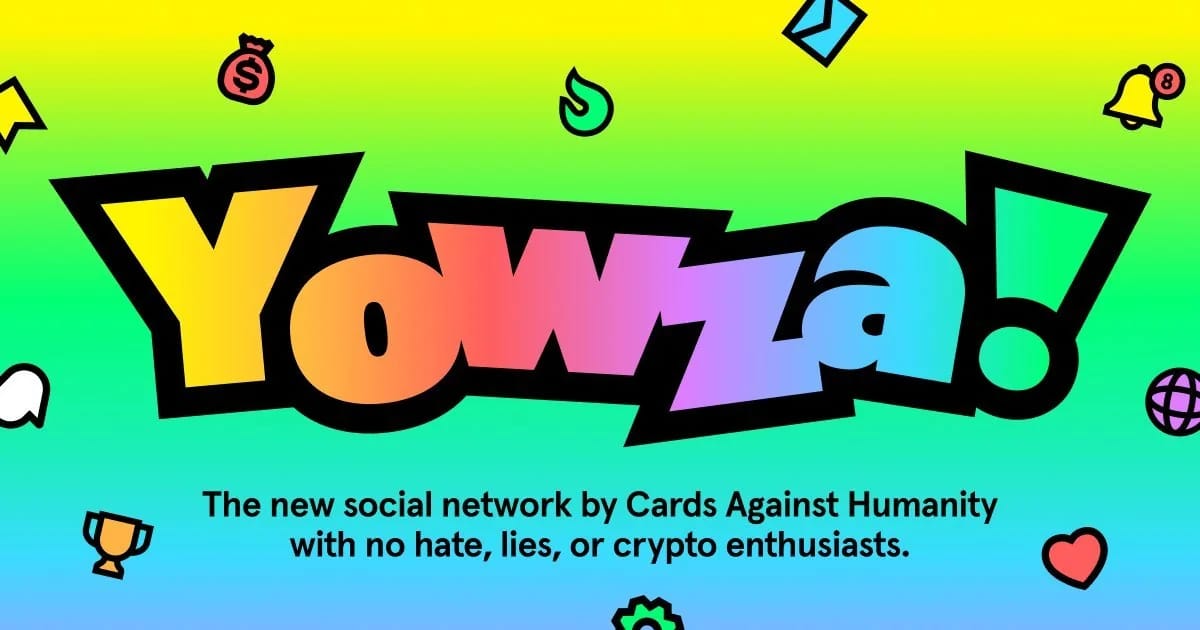
In 2023, the brand debuted Yowza!, a parody of Twitter/X that was positioned as a social network with “no hate, lies, or crypto enthusiasts.” No matter what users typed into the platform, the only thing posted was the word “yowza.” A tiered referral system helped get people onto the platform:
the first 10,000 people who referred a friend earned $4.20
the top 2,500 referrers got a free copy of the board game Head Trip
the top 420 referrers won $69
the No. 1 referrer earned $69,420
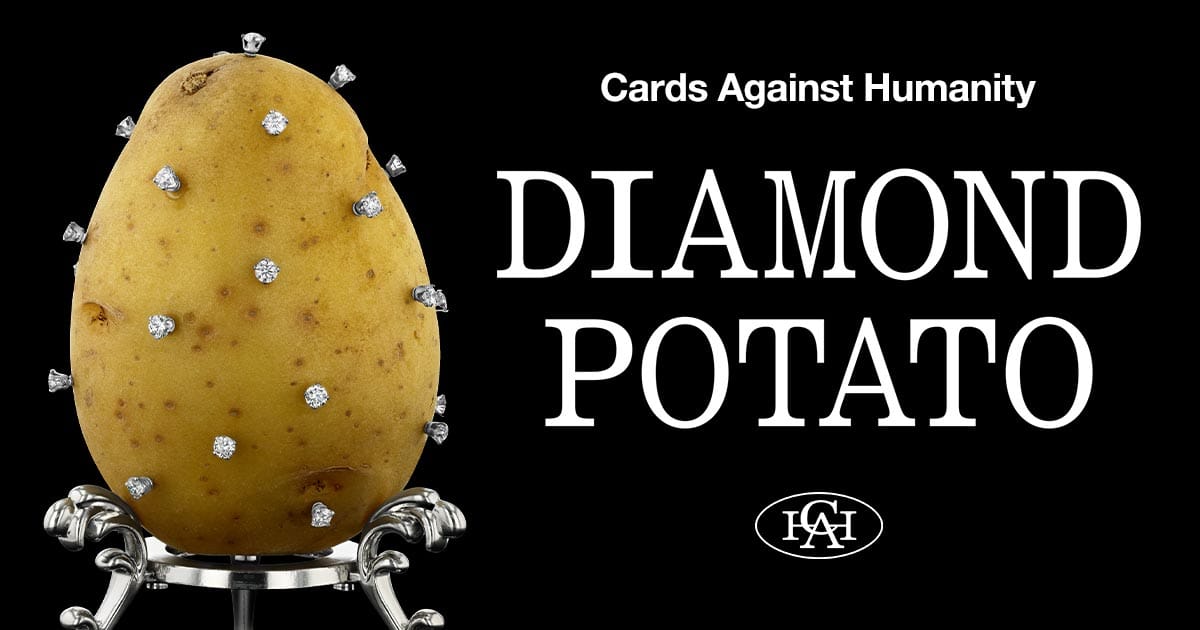
CAH’s 2024 activation leaned back into physical absurdity with the Diamond Potato. It was a real potato covered in lab-grown VVS diamonds that they sold for a flat $69.99 (even though it was valued at over $1,000).
The Results
Over 11 years, Cards Against Humanity made its brand into a reliable source of annual holiday disruption. Their Black Friday stunts regularly earned national press coverage and dominated social feeds without relying on paid media.
Across the years, the brand’s Black Friday ideas continued to drive significant participation despite offering very little in return. Over 30,000 people bought Bullshit in 2014. More than 11,000 customers paid $5 for nothing in 2015. The Holiday Hole stunt in 2016 drew six figures in contributions simply to keep a backhoe digging.
Other activations drove major traffic spikes and high-volume engagement online. The 2018 “99% Off Sale” turned real items—like jewelry, electronics, and even cash—into viral spectacle as fans raced to check out before listings disappeared. The 2019 A.I. Challenge inspired side-by-side sales competition between human-written and AI-written card packs (for the record, the humans sold more). In more recent years, participation scaled with digital mechanics: the 2023 Yowza! stunt brought in thousands of referrals, and the 2024 Diamond Potato sold out in under 30 minutes.
Taken together, these stunts created a durable brand ritual that fans returned to every November. By turning Black Friday into a cultural tentpole rather than a discount opportunity, Cards Against Humanity built a decade of earned media that set the brand apart.
The Takeaways
1) Build a brand tradition people look forward to
Cards Against Humanity didn’t treat Black Friday as a standalone campaign, they treated it as an annual ritual. Over 11 years, the brand trained fans and media to expect a new stunt every November. And each activation benefited from the equity of the years before it, meaning even small ideas carried the weight of a longstanding narrative.
Consider echoing this approach by identifying one or two cultural moments each year and turning them into recurring signature activations. Whether it’s tax season, back-to-school, summer travel, or an industry-specific moment, consistency compounds. Pick a theme, set tonal “rules,” and build upon it annually so audiences know when and why to pay attention.
2) Opt for simplicity in your strategy.
Par of the power in Cards Against Humanity’s Black Friday work is the simplicity of the premise. One joke per year that’s executed with total commitment. The team didn’t layer on complex messaging frameworks, multimodal rollouts, or traditional conversion paths. The stunts were always clear, shareable, and hard to ignore.
It’s easy (and tempting) to over-engineer big ideas. Instead, focus on crafting one surprising, concise concept that can be explained in a single sentence. And if it can be repeated easily and screenshot well, even better.
3) Use constraints to drive creativity.
Each CAH Black Friday activation operated under self-imposed constraints of simplicity. These boundaries forced sharper thinking and prevented campaigns from becoming bloated or unfocused. And the result was a tight creative system that fans could instantly recognize, no matter how different each year’s concept appeared.
Establishing creative constraints like format, tone, or structural rules can unlock more original work, not less. A recurring constraint acts as the container, while each year’s idea becomes the variation inside it. When you simplify the sandbox, you free up more headspace for the twist, the stunt, or the moment you’re trying to create.
Don't miss the next Case Studied™.
Join 40,000+ marketers and receive a breakdown of the world's best brands every week.